
PVC-based options
Discuss PVC sheet and coated or reinforced fabric options for your design.
Specify: reinforcement, thickness, finish and color.
MATERIALS & COMPONENTS / OEM DEVELOPMENT
From TPU and PVC material selection to welded seams, closures and sample validation, define the construction behind your custom waterproof bags. Use this technical overview to build a clearer OEM brief and compare finished samples with your purchasing requirements.
Discuss your material brief01 / THE MATERIAL FOUNDATION
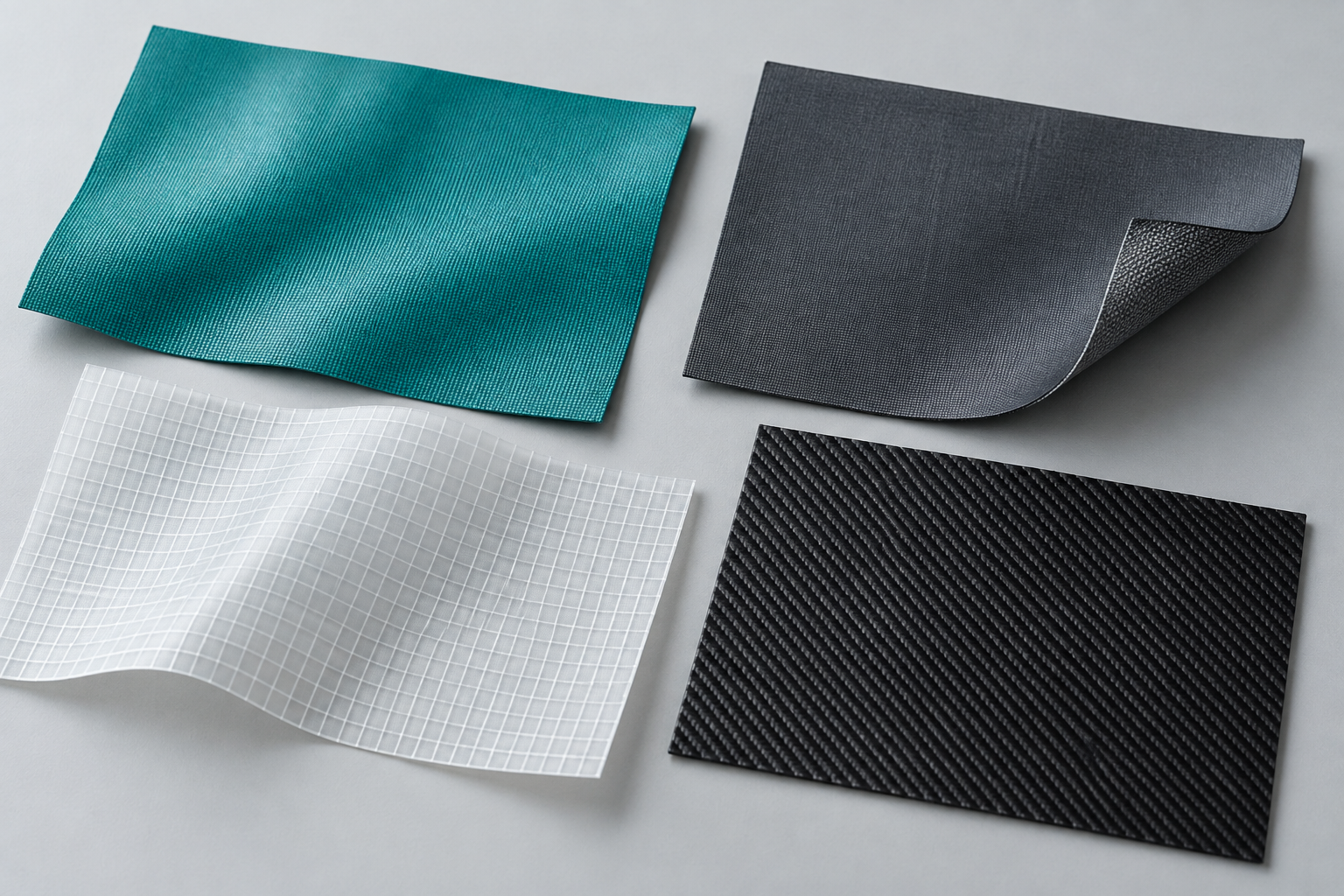
Your drawing, reference sample and intended use help define the base fabric, coating or film, thickness, surface finish and construction requirements.
Discuss PVC sheet and coated or reinforced fabric options for your design.
Specify: reinforcement, thickness, finish and color.
Review film or laminated fabric choices against the product structure and sample brief.
Specify: substrate, laminate construction and hand feel.
Define the nylon or polyester base and the required coating instead of relying on fabric appearance alone.
Specify: weave, fabric weight, coating and reverse finish.
| Construction | Useful specification fields | Review on a finished sample |
|---|---|---|
| TPU film or TPU-laminated fabric | Film or laminate build, textile backing, thickness, coating sides and finish. | Flexibility around the opening, seam transitions, abrasion areas and accessory interfaces. |
| PVC sheet or PVC-coated fabric | Sheet or reinforced construction, base textile, thickness or coating weight, surface and colour. | Fold behaviour, panel handling, weld appearance and reinforcement around handles. |
| Coated nylon or polyester | Fibre type, yarn reference, weave, coating or laminate identity and coated side. | How the seam and closure protect the intended compartment; how coating behaves at folds. |
| Insulated bag assembly | Outer shell, liner, insulation type and thickness, lid and base layout. | Usable space, continuity of insulation, liner junctions and closure operation. |
Denier describes yarn linear density; it does not identify the coating, finished fabric thickness or waterproof rating. Keep denier, material weight in g/m², thickness in mm and coating or laminate construction in separate fields. When comparing custom TPU dry bags and custom PVC dry bags, ask for the full material build and physical swatches rather than treating one label as a complete specification.
Define the expected environment as well as the material: repeated folding, contact with equipment, storage temperature, salt-water exposure and cleaning needs can affect the development brief. Ask which material options are appropriate for that use, and agree any required evaluation before approving a substitution. See the TPU versus PVC sourcing checklist.
Material availability and suitability are confirmed during quotation and sampling. No performance rating is implied by these illustrations.
02 / TECHNICAL DEVELOPMENT
A waterproof bag is an assembly. Material compatibility, joint geometry and repeatable production conditions matter as much as the visible surface finish.
RF welding uses a rapidly alternating electric field to generate heat in compatible thermoplastics at the joint. PVC and polyurethane are commonly used material families, but the actual coating or laminate must be reviewed for compatibility. The textile backing and layer arrangement also belong in the seam specification.
For an RF-welded waterproof bag project, review the weld path, overlap, tooling access and transitions between layers. Corners, zipper ends and attachment junctions deserve separate attention because their geometry differs from a straight body seam.
Where a thermal joining process is proposed, confirm the material and joint arrangement with a sample. Different joining methods are not interchangeable simply because the finished line looks similar.
Stitching can form handles, harnesses and accessory assemblies. If stitching passes through a compartment intended to retain water or air, the complete construction needs a defined sealing approach and evaluation. Position load-bearing attachments so their reinforcement can be reviewed with the protected shell.
| Development point | Why it matters | Sample review record |
|---|---|---|
| Joint geometry | Overlap, bends and multi-layer transitions affect how a seam is formed. | Drawing revision, seam location and photographs of representative areas. |
| Process setup | Energy or temperature, pressure and time must suit the selected material and tooling. | Agreed sample construction and process-validation scope; no universal setting inferred. |
| Visible workmanship | Alignment and continuity help identify areas for closer review. | Location-marked observations and the approved appearance reference. |
| Joint and bag performance | A neat weld appearance does not establish finished-bag performance. | Agreed seam evaluation and separate complete-bag test, where required. |
Use the welded-seam inspection guide to prepare a location-based sample review. Our equipment overview provides production references; the process route for an order is reviewed against its materials and construction.
03 / TECHNICAL DEVELOPMENT
Opening size, closing sequence and the surrounding seam construction determine how a closure works in the complete bag.
| Closure format | What to define | What to evaluate |
|---|---|---|
| Roll-top opening | Usable closed dimensions, required roll sequence, stiffener and buckle arrangement. | Closure with the reference contents packed; access, folds and attachment positions. |
| Water-repellent zipper | Exact component specification, installation and expected splash or rain exposure. | Slider operation and the complete zip area under the agreed conditions. |
| Waterproof / airtight zipper design | Component identity, end construction, installation, operation and intended retention requirement. | The assembled closure and surrounding joints, using a defined test scope. |
| Valve or functional fitting | Purpose, interface, placement, cap access and replacement requirements. | Operation and the fitting-to-shell interface on the finished sample. |
A coated zipper should not be described as watertight from appearance alone. Water exposure and air retention also need different test conditions. State the exposure, orientation, duration and acceptance criteria for the compartment you are buying. Do not transfer the performance of a component to the whole bag without evaluating its installation.
For example, a roll-top riding backpack and a zip-access cooler have different access needs. Compare the 40L roll-top backpack reference with the 6L zip-access cooler reference to see how opening format changes the product brief.
04 / FUNCTIONAL COMPONENTS
Match each component to the bag design, carrying method and closure requirements.
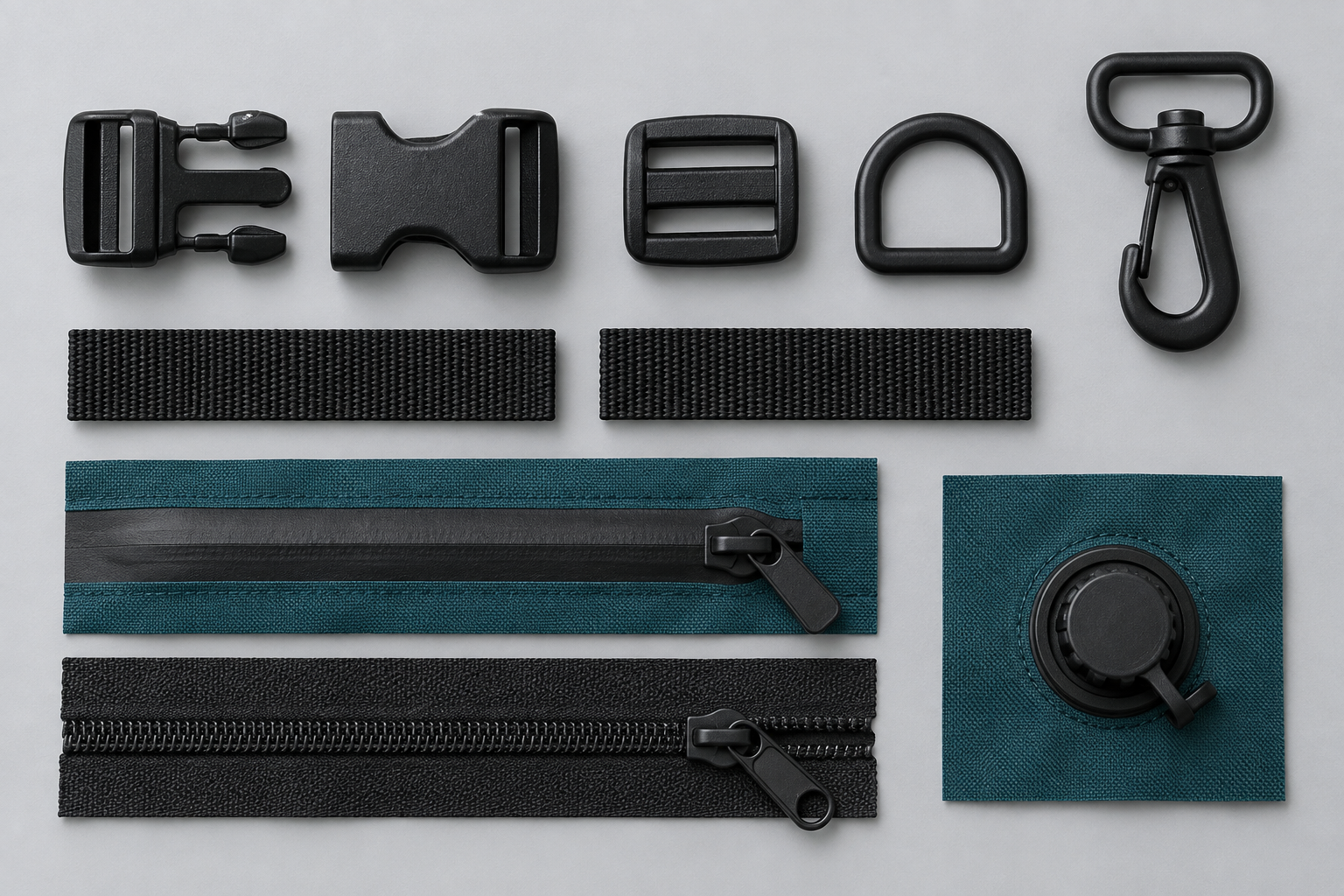
Define opening size, slider arrangement and the required water or air retention performance. A coated zipper appearance alone does not establish a waterproof or airtight rating.
Confirm strap width, adjustment range, buckle pairing, attachment positions and any load requirements in the sample brief.
Where the design needs a valve, agree its purpose, placement, cap access and interface with the bag before sampling.
Review logo artwork, print position, woven labels or patches, and packaging as part of the complete product specification.
| Component group | Details to lock before production | Practical review |
|---|---|---|
| Webbing and buckles | Width, adjustment range, mating parts, colour and end treatment. | Operate together; check adjustment with the intended load and use. |
| Handles and shoulder systems | Handle clearance, strap layout, padding, anchor placement and reinforcement. | Pack the sample; check balance, access and carrying fit. |
| Prints, patches and labels | Artwork revision, decoration method, dimensions, position and colour reference. | Approve on the selected surface; review detail and expected folding areas. |
| Packing and instructions | Individual packing, closure instructions, labels, barcode position and carton marks. | Review unpacked appearance and the instructions supplied to the end user. |
For logo placement, measure from a fixed panel edge or seam and approve the artwork at its actual production size. If decoration changes the material surface or overlaps a fold or joint, review that area on the sample. See the artwork approval checklist for bulk and private-label orders.
05 / TECHNICAL DEVELOPMENT
Define a test plan before treating a sample as an approved production reference. Keep material evaluation, seam checks and complete-product results distinct.
| Question | Define in the test brief | Useful result record |
|---|---|---|
| Will the compartment resist the intended water exposure? | Load, closure state, orientation, exposure method, duration and acceptance criteria. | Sample ID, setup, observations and result for that configuration. |
| Does an airtight construction meet the agreed requirement? | Closure, valve state, pressure or other agreed method, duration and permitted change. | Method, conditions, instrument details and measured observations. |
| Will handles and straps suit the intended packed load? | Load reference, attachment points, handling sequence and required acceptance criteria. | Sample construction, locations inspected and outcome. |
| How should a cooler be compared? | Contents, cooling media, start temperature, ambient conditions, sensor position and opening schedule. | Time and temperature observations, linked to the tested insulation and closure. |
| Will decoration and materials meet the buyer’s specification? | Colour reference, handling or abrasion evaluation and required destination-market documentation. | Applicable sample or material identity and document scope. |
Tell our team the product model, destination market and specific test or certification documentation you require. We will discuss what documentation can be provided for that requirement. A material document, a component document and a complete-product report have different scopes.
Any rating or numerical performance claim should be supported by evidence applicable to the supplied design. This page describes development and inspection considerations; it is not a test certificate.
Continue with the finished-bag inspection checklist or the cooler temperature-test planning guide.
06 / FROM REFERENCE TO APPROVED SAMPLE
Send a drawing, an existing sample or a short description. These are the details to resolve together.
| Specification | What to share | What to confirm |
|---|---|---|
| Use & bag structure | Activity, dimensions, capacity and carrying method | Panel layout, opening and attachment positions |
| Material & finish | Reference swatch, color and preferred hand feel | Composition, thickness or weight, and final finish |
| Closures & hardware | Closure preference, strap layout and functional needs | Component dimensions, fit and operation |
| Branding | Logo artwork, placement and color reference | Application method, size and sample appearance |
| Performance & acceptance | Required use conditions and any buyer test protocol | Test method, acceptance criteria and evidence required |
Share the intended contents, load, dimensions, exposure, quantity and destination market.
Resolve shell, seams, closure, carrying parts, insulation where applicable, branding and packing.
Check the agreed functions and test scope; record changes against a dated sample and specification.
Keep the approved references with the order. Review proposed substitutions before they enter production.
SAMPLE BEFORE PRODUCTION
Confirm the material swatch, component selection and finished sample together. Any waterproof, airtight or load requirement needs an agreed test scope and sample verification before it becomes a product claim.
07 / TECHNICAL DEVELOPMENT
Use the same specification framework across a collection, while resolving the details for each bag structure.
Prioritise usable closed space, roll-top or zip-access format, seam layout and carrying attachments. Confirm the shell build and agreed exposure requirements.
Explore custom waterproof bags →Combine compartment protection with packed-load carrying fit, shoulder adjustment, front storage and access. External pockets need their own construction review.
Review backpack manufacturing →Specify the outer shell, liner, insulation and closure separately. Review cooling performance, internal liquid retention and external water exposure as distinct requirements.
Compare cooler constructions →Existing models with your logo start at 50 pieces; new OEM development starts at 100 pieces. OEM sampling normally takes 10–15 days, with a typical sample fee of US$15–500 depending on style and materials. Regular bulk production takes 10–15 days; confirm the schedule and delivery terms for your specific order.
Send your reference, target quantity, material preference and technical requirements. Review the OEM and ODM process or discuss your technical brief with our team.
08 / TECHNICAL DEVELOPMENT
Use these references to clarify process and component terminology when preparing your enquiry.
A material and closure brief needs to be translated into an assembled sample. These photographs show the workshop environment and production workstations. Discuss the selected material, joint locations and closure arrangement for the exact product you plan to source.
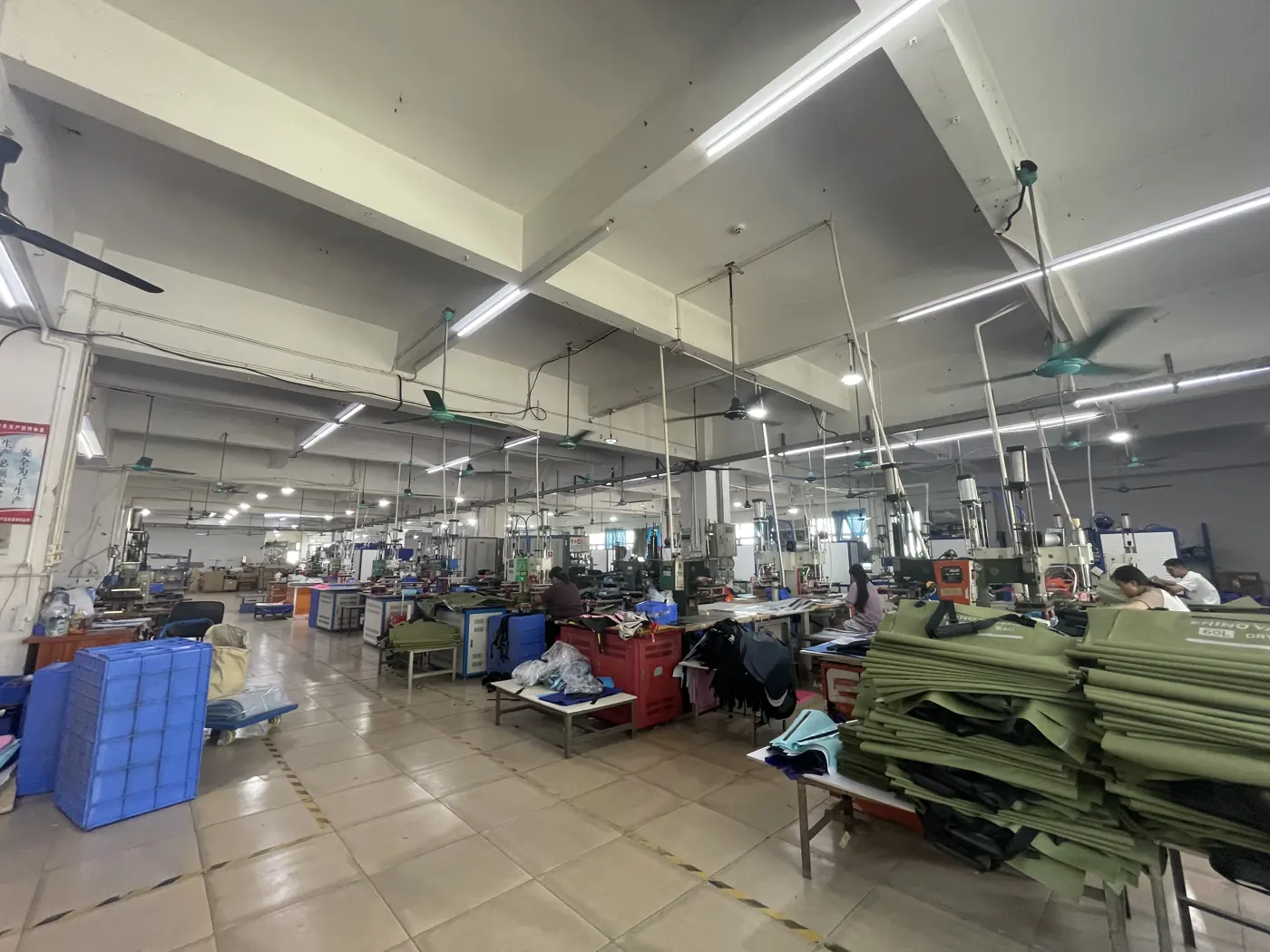
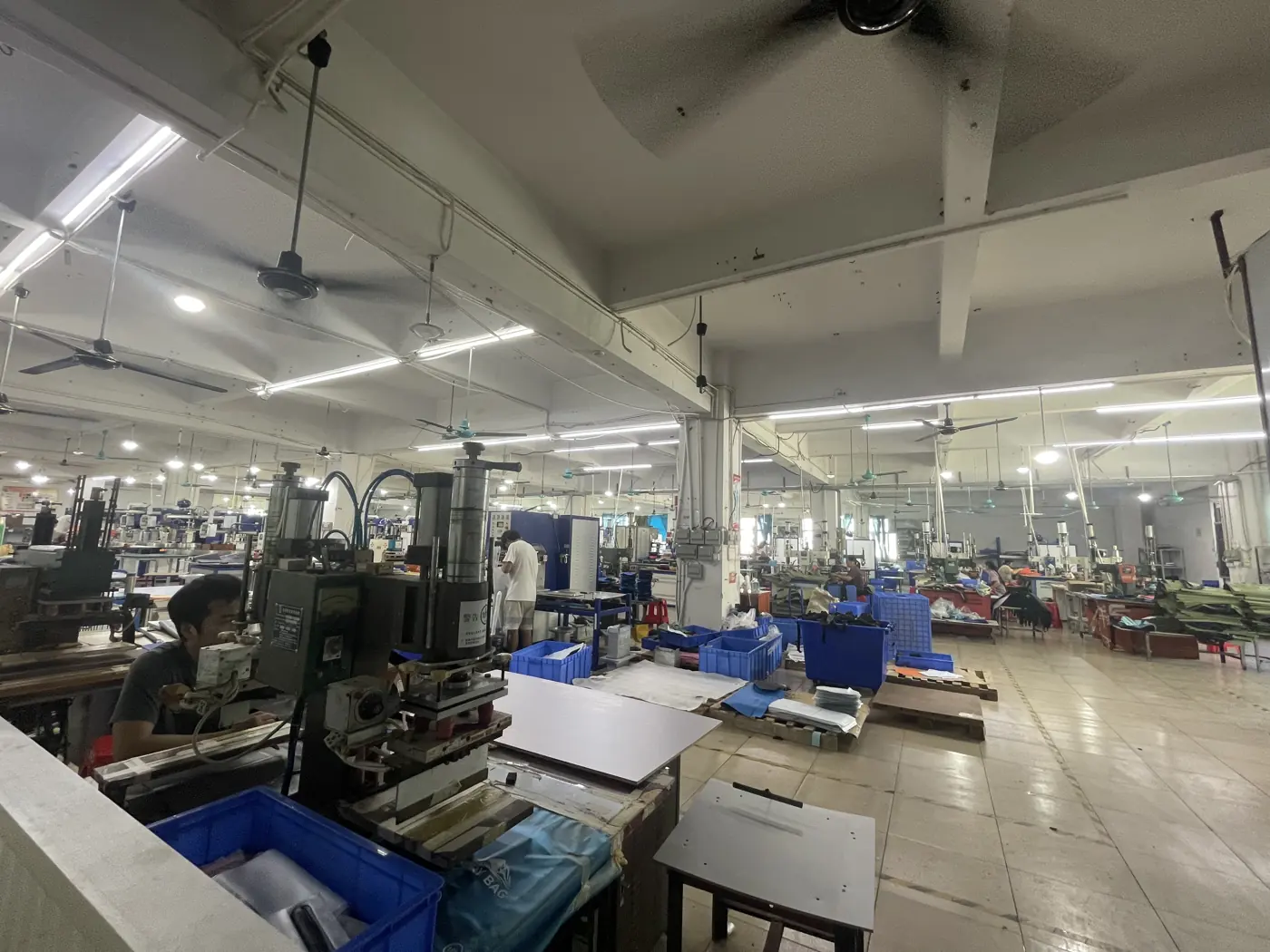
Keep photographs, the sample ID and specification revision together in your sample review record. Workshop images document the environment; product performance and certification require separate model-specific evidence.
Share your quantity, destination market and customization requirements. MOQ, sample timing, production schedule and pricing are confirmed for your project.